We are now all familiar with new AI tools such as ChatGPT, Claude or Gemini. Many people have already experimented with them. Asking a question, having a text written, or getting a difficult concept explained. It feels like you have a smart colleague sitting next to you who comes up with answers at lightning speed. But anyone who has worked with these tools for longer also knows how deceptive that can be. Sometimes the answers sound very convincing, while they later turn out to be incorrect. After all, it remains a system that builds knowledge from enormous amounts of information on the internet and in books. Errors, assumptions and incorrect combinations can easily slip in.
That is exactly what many organizations struggle with. As an employee, you do not want to endlessly search through manuals, intranet pages or policy documents. You want the right answer, quickly and correctly. But you also do not want the risk of an AI system making something up that does not fit the way your organization works. In some sectors, such as childcare, healthcare or financial services, this can even have major consequences. An employee at a daycare center who is looking up how to deal with a sick child must receive an answer that follows the organization’s agreements, not advice that happens to be recommended somewhere online.
This is where AI agents come into play. An AI agent uses the same speed and reasoning power as generative AI, but is trained with information that you, as an organization, consider reliable. Not everything that exists online, but specifically your processes, your way of working, your knowledge. You teach an agent what good information is and how it should be applied in your context. It is essentially the same as onboarding a new colleague. You show where the manuals are, which exceptions matter and how you communicate with each other. The difference is that this colleague never guesses, never gets tired and is always available. (Use the language button in below image to choose your preference and the other top buttons for extra views)
Another metaphor is cooking. If you ask a generic AI tool how to prepare pasta, you get an answer based on general knowledge. Drawing from many different recipes, or simply the most common one, it explains how to prepare your pasta. An AI agent, on the other hand, works with your specific recipe. It is still a cooking expert, but now one that knows exactly what your guests expect, which ingredients are in the pantry, how you present your dishes and which preparation approach makes the difference or sets you apart.
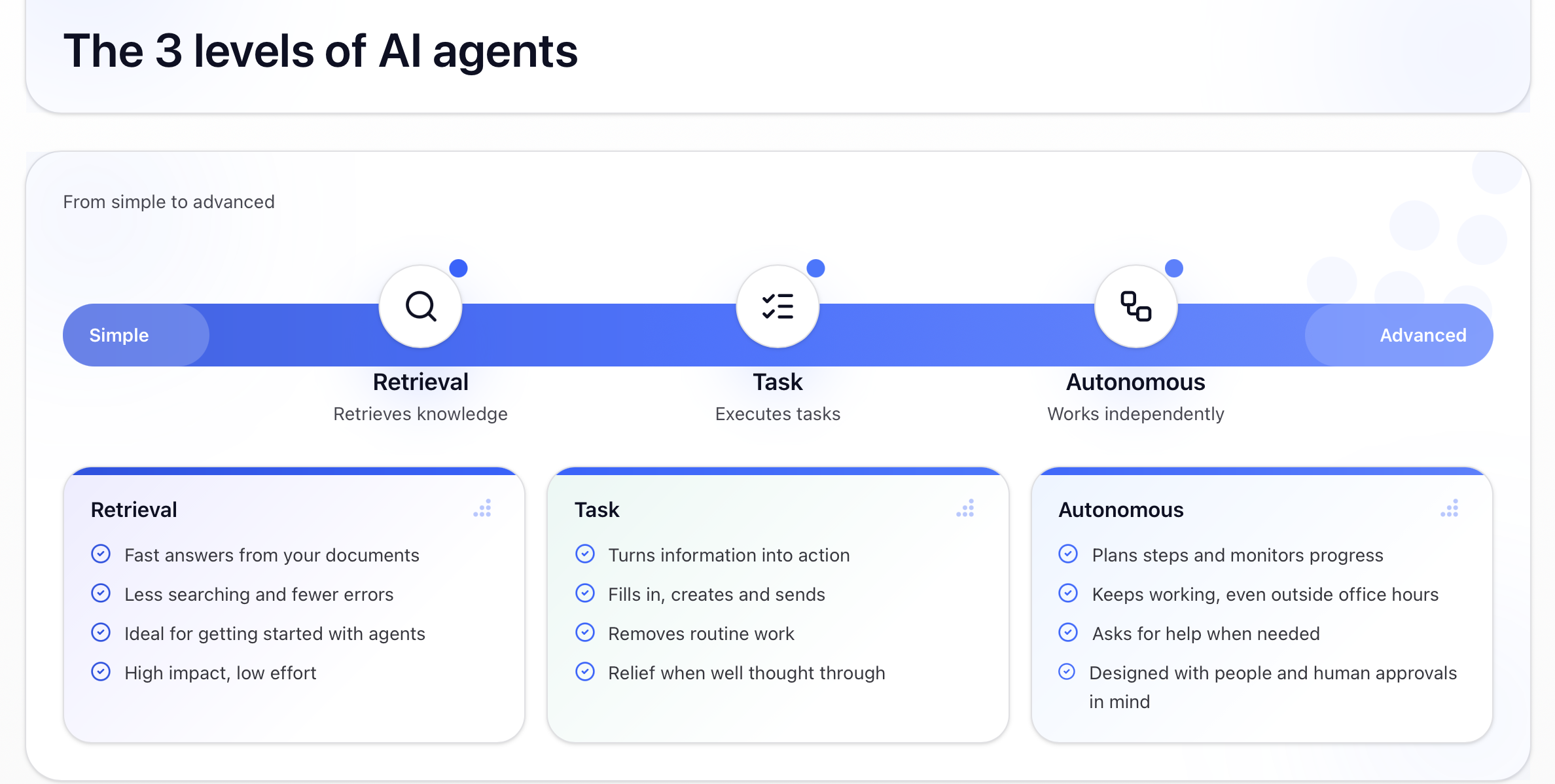
These types of agents can be deployed at different levels. The easiest agent to set up is one that helps employees or customers quickly find the right information within the knowledge the organization has already built. This leads to significant time savings. It prevents searching and reduces errors. The customer or colleague receives a reliable answer within seconds. There are organizations where this step alone already results in shorter waiting times, fewer escalations and a much better experience. In technical terms, this is called a Retrieval Agent. This is where the first love for AI comes from. Instead of searching via, for example, Google and then clicking through each result to see whether it actually relates to what you were looking for, you now receive a summary of the most important results. In natural language, you can immediately indicate whether this is what you were looking for or whether you meant something else. It saves a lot of clicking, a lot of frustration about finding the right search terms, and you consult many relevant sources much faster. A Retrieval Agent does exactly that. It searches only the sources you have approved and therefore only provides information that you, as an organization, have determined to be relevant.
The next step consists of agents that actually carry out tasks, often referred to as task-oriented agents. They generate reports, fill in forms, send confirmations or process requests. These are tasks that normally take a lot of time and offer little satisfaction. By automating this work, organizations create space for employees to spend more time on areas where human attention is truly needed.
Ultimately, we arrive at agents that can work independently, also called autonomous agents. They do not only plan the steps needed to complete a task, but also monitor progress themselves and recognize when help is required. They can connect multiple processes and keep working even when no one is watching. You can think of them as a colleague who keeps things running overnight, so that the next morning you can continue at a point where everything has already been prepared for you.
The essence of AI agents is therefore not technology for the sake of technology. It is about working smarter. Tasks that take a lot of time and add little value fade into the background. People can focus on what is creative, human and strategic. The convenience and time savings are immediately noticeable. And contrary to what is sometimes assumed, you do not have to be a technologist to get started. The most important question is simple: which tasks would you most like to stop doing yourself tomorrow?
That is the moment to let an agent take over the work. The step that follows is discovering how much more enjoyable and effective work becomes when digital colleagues handle the routine tasks for you.